

Dr Solomon Abebe Haile
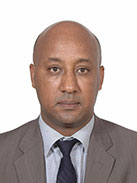
Global Land Tool Network II Urban Legislation, Land and Governance Branch, UN-Habitat II, Kenya
Biography
Solomon Haile has since 2007 been working at the United Nations Human Settlements Program (UN-Habitat) as human settlements officer initially having responsibility for land related capacity development and later for a variety of initiatives focusing on land tools development. In this capacity, he has task managed the development and implementation a number of training and capacity development resources in a number of areas including transparency in land administration and land governance, gender, and grassroots participation. Also, he spearheaded at the prototype development stage the development of a pro-poor land information management software (LIMS) called Social Tenure Domain Model (STDM) including active involvement in the ISO TC 211 (as the sole representative of the developing world) which eventually resulted in the Land Administration Domain Model (LADM).
After moving to Land, Tenure and Property Administration Section (LTPAS) in September 2010 (it is now called Land and GLTN Unit of the Urban Legislation, Land and Governance Branch), he continued to serve as a focal person land and housing rights in Islamic contexts, costing and financing of land administration services and land value sharing. He has recently expanded his involvement and been instrumental in establishing the urban legislation practice as organizational unit and as a new potential area of engagement with member states, cities and local governments. Solomon is an anchor person in the Land GLTN Unit for land readjustment including land legislation. He is also leading a project which is entrusted with developing capacities in Africa within the framework of the African Land Policy Initiative. Before joining UN-Habitat, Solomon worked as a development planner for the Ethiopian Government for over 15 years. This included heading the Bureau of Planning and Economic Development of the Amhara State and providing strategic leadership to the SidaAmhara Rural Development Program (SARDP).
Solomon Holds MSc and PhD in geoinformatics, satellite remote sensing and land management which he obtained from Faculty of Geo-Information Science and Earth Observation (ITC) of the University of Twente in the Netherlands and Institute of Surveying, Remote Sensing and Land Information, Department of Landscape and Spatial Infrastructure Sciences of the Vienna University of Natural Resources and Applied Life Science (BOKU). The title of his PhD thesis is Bridging the Land Rights Demarcation Gap in Ethiopia: Usefulness of High Resolution Satellite Image (HRSI) Data.
Abstract
The relevance of land readjustment as a tool to deliver better community engagement, fix-up informal land systems, and improve the supply of serviced urban land in developing countries.
Land readjustment is one of the oldest land management instruments that local governments and countries at large have employed to improve the availability of serviced urban land in and around cities. It has proven to be exceptionally useful in countries like Germany, Japan, Spain, South Korea, Turkey, Thailand and Colombia. In some of these countries, a third of the built-up environment is created or recreated using land readjustment.
In recognition of its potential to rationalize land allocation and use in and around cities of developing countries, land readjustment is one of the eighteen tools that the GLTN identified for further research and innovation with a view to making it attuned and respond to complex realities of informal urbanization. Very recently, land readjustment has gained considerable currency as a tool that will help reduce informality by changing discourse and engagement with communities in and around informal settlements, improving the availability of land through negotiated processes, providing pathways that may allow mobilization of financial resources (for example through land value sharing or land based financing) within and around communities that land readjustment projects are likely to affect.
Among other things, land readjustment typically requires a reasonably functioning land administration and land and property valuation systems. These systems don’t exist in the informal settlements of developing countries or in disrepair. The potential use and success of land readjustment in such contexts therefore is contingent upon the creation and revitalization of such systems through pro-poor, affordable, fir-for-purpose, inclusive, etc process and approaches. These processes and approaches very much underpin GLTN’s work and most recently reflect UN-Habitat’s thinking following the identification of Participatory and Inclusive Land Readjustments (PILaR) as the Agency’s flagship project .
This presentation outlines opportunities, challenges and risks associated with the afore-mentioned thinking and more importantly the emerging practice. It presents the promise that LR in general and PILaR in particular hold in realizing the goals of the New Urban Agenda with emphasis on managing informality. In so doing, the contribution does not only aim to sensitize the geospatial communities, but also to engage them with a view to soliciting their feedback and input on the subject.